Recipe · Sourdough · Slow-Fermented
75% Hydration Slow-Fermented Sourdough
Sourdough relies on wild yeast cultured from a starter, and that starter does most of the work. The long ferment pulls real flavor out of the flour, gives you a chewy, open crumb, and produces the sour notes that commercial yeast can't match.
Total time
36 hours (over ~3 days)
Active
90 minutes
Hydration
75%
Difficulty
⌬⌬⌬
75% hydration sits in the middle for a reason. The dough is soft enough for an open crumb, firm enough to handle, and hits the sweet spot for most artisan styles. Most home bakers spend most of their time here.
The slow schedule is for bakers who plan ahead. Mix Friday, fold and refrigerate, shape Saturday, ferment again, bake Sunday. The time produces depth that a shorter schedule simply can't reach, and the dough is a pleasure to handle by the end.
Ingredients
1000g total dough. Yields 1 boule, ~900g baked.
| Ingredient | Grams | Baker's % |
|---|---|---|
| Bread flour | 508 g | 100% |
| Water | 381 g | 75% |
| Salt | 10.2 g | 2% |
| Active sourdough starter (100% hydration) | 101.6 g | 20% |
Schedule
- Day 1, eveningMix flour and water. Autolyse 1 hour.
- Day 1, eveningAdd starter and salt. Mix gently.
- Day 1, eveningThree folds, 30 minutes apart.
- Day 1, nightRefrigerate the bulk dough overnight.
- Day 2, morningPull from refrigerator. Bench rest 1 hour.
- Day 2, middayPre-shape, rest 30 minutes. Shape into a tight boule, place seam-up in a floured banneton.
- Day 2, afternoonCover and refrigerate the shaped dough overnight.
- Day 3, morningPull from the refrigerator. Preheat the oven and Dutch oven to bake temperature.
- Day 3, morningScore the loaf. Bake at 500°F covered for 25 minutes, then uncovered for 20 more minutes. A bread pan like the Challenger works here too.
Method tips for this style
The starter has to be active and bubbly within four to six hours of feeding. If it doubles in that window, it's ready. A sluggish starter produces a sluggish loaf, regardless of schedule or hydration.
What to expect
A balanced open crumb with visible holes and a chewy texture. The crust is thin but sturdy, and the flavor is a clean read on the flour and ferment.
What you'll need for this bake
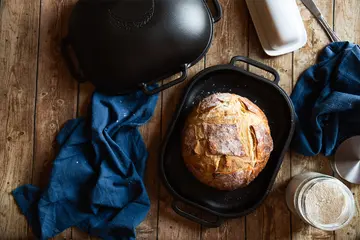
Featured pick
Challenger Bread Pan
Cast iron with a shallow base you load dough onto instead of dropping it into a hot pot. The tall lid traps steam over a round or oval loaf.
See it at ChallengerEscali Primo Scale
NY Times recommended. 11 lb capacity, 1g accuracy, simple two-button operation.
OXO Bench Scraper
Stainless steel blade with measurement markings. Comfortable non-slip grip.
ThermoWorks Thermapen
Pro-grade accuracy in 1 second. Check water temp and bread doneness (190-210°F).
Lodge Combo Cooker
The go-to choice for home bakers. Shallow lid makes loading dough safer and easier.
Banneton Basket Set
Round & oval baskets with liners, lame, and scrapers. Premium Indonesian rattan.
UFO Bread Lame
Handcrafted walnut wood handle with secure blade storage. Includes extra blades.
Affiliate Disclosure: As an Amazon Associate I earn from qualifying purchases. This means I may receive a small commission if you buy through my links, at no extra cost to you. I only recommend products I genuinely believe will help your bread baking journey. Thank you for supporting The Dough Formula! Some links go to other retailers who also pay me a commission.
More Recipes
75% Hydration Overnight Sourdough
European style · Advanced
75% hydration
75% Hydration Slow-Fermented Baguette
French style · Advanced
75% hydration
65% Hydration Slow-Fermented Sourdough
European style · Advanced
65% hydration
Related Guides
A Beginner's Guide To Sourdough
Starter, schedule, and a simple country loaf to learn on. The shortest path from no experience to a good sourdough boule.
Feb 10, 2026
Baker's Percentages Explained For Home Bakers
The universal language of bread bakers, in plain English. Learn how flour always equals 100% and why that makes every recipe scale instantly.
Feb 8, 2026