Recipe · Country Loaf · Slow-Fermented
75% Hydration Slow-Fermented Country Loaf
The pain de campagne approach: not pure white, not aggressively whole-grain, but a balanced mix that bakes into something with depth. Slightly tangier than a plain loaf, slightly sweeter than pure sourdough, and a workhorse for the kitchen.
Total time
36 hours (over ~3 days)
Active
90 minutes
Hydration
75%
Difficulty
⌬⌬⌬
At 75%, you get real artisan crumb without fighting the dough. It's wet enough for visible holes in the cut loaf, dry enough that you can shape it on a lightly floured counter without the dough sticking to everything.
A 24 to 48 hour ferment is the professional approach scaled to a home kitchen. The dough rests in the refrigerator for most of its life, gluten develops without effort, and the bake produces a crust and crumb that read as serious bread.
Ingredients
1000g total dough. Yields 1 country loaf, ~900g baked.
| Ingredient | Grams | Baker's % |
|---|---|---|
| Bread flour | 381 g | 75% |
| Whole wheat flour | 127 g | 25% |
| Water | 381 g | 75% |
| Salt | 10.2 g | 2% |
| Active sourdough starter (100% hydration) | 101.6 g | 20% |
Schedule
- Day 1, eveningMix flour and water. Autolyse 1 hour.
- Day 1, eveningAdd starter and salt. Mix gently.
- Day 1, eveningThree folds, 30 minutes apart.
- Day 1, nightRefrigerate the bulk dough overnight.
- Day 2, morningPull from refrigerator. Bench rest 1 hour.
- Day 2, middayPre-shape, rest 30 minutes. Shape into a tight boule, place seam-up in a floured banneton.
- Day 2, afternoonCover and refrigerate the shaped dough overnight.
- Day 3, morningPull from the refrigerator. Preheat the oven and Dutch oven to bake temperature.
- Day 3, morningScore the loaf. Bake at 475°F covered for 25 minutes, then uncovered for 20 more minutes. A bread pan like the Challenger works here too.
Method tips for this style
Hydrate the whole-grain portion separately for 30 minutes before adding the white flour. The whole grains absorb water more slowly, and pre-soaking them gives a more even final hydration in the dough.
What to expect
A balanced open crumb with visible holes and a chewy texture. The crust is thin but sturdy, and the flavor is a clean read on the flour and ferment.
What you'll need for this bake
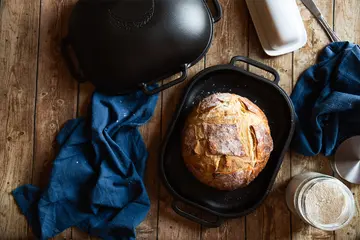
Featured pick
Challenger Bread Pan
Cast iron with a shallow base you load dough onto instead of dropping it into a hot pot. The tall lid traps steam over a round or oval loaf.
See it at ChallengerEscali Primo Scale
NY Times recommended. 11 lb capacity, 1g accuracy, simple two-button operation.
OXO Bench Scraper
Stainless steel blade with measurement markings. Comfortable non-slip grip.
ThermoWorks Thermapen
Pro-grade accuracy in 1 second. Check water temp and bread doneness (190-210°F).
Lodge Combo Cooker
The go-to choice for home bakers. Shallow lid makes loading dough safer and easier.
Banneton Basket Set
Round & oval baskets with liners, lame, and scrapers. Premium Indonesian rattan.
UFO Bread Lame
Handcrafted walnut wood handle with secure blade storage. Includes extra blades.
Affiliate Disclosure: As an Amazon Associate I earn from qualifying purchases. This means I may receive a small commission if you buy through my links, at no extra cost to you. I only recommend products I genuinely believe will help your bread baking journey. Thank you for supporting The Dough Formula! Some links go to other retailers who also pay me a commission.
More Recipes
75% Hydration Same-Day Country Loaf
French style · Advanced
75% hydration
75% Hydration Slow-Fermented Sourdough
European style · Advanced
75% hydration
65% Hydration Slow-Fermented Country Loaf
French style · Advanced
65% hydration
Related Guides
The Country Loaf (Pain De Campagne)
A rustic mix of bread flour, whole wheat, and rye, leavened with a levain. The classic French country loaf as a home baker can make it.
Mar 22, 2026
Baker's Percentages Explained For Home Bakers
The universal language of bread bakers, in plain English. Learn how flour always equals 100% and why that makes every recipe scale instantly.
Feb 8, 2026